Many people think of daylilies as the wild orange flowers growing beside roadways across the country. Yet those wild species of flowers have been refined by years of hybridizing to the point where it’s hard to believe that the old and the new are even related! Leaving dull orange decades behind, today’s modern daylilies have been developed into a diverse spectrum of colors, patterns, sizes, and shapes. Tropical and exotic by nature, many are fragrant and have nocturnal blooming habits. This makes daylilies ideal for summer evening patio enjoyment.
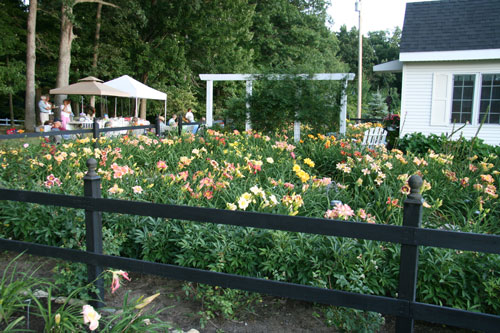
Their scientific name, Hemerocallis, means “beauty for a day.” Each daylily blossom lasts for only one day. However, with many buds and lots of scapes, an established plant can be in bloom for several weeks or even longer. Many cultivars will also rebloom several times during one growing season, further extending the flower’s bloom season. Each individual daylily has its own inbred blooming traits and season.
When do daylilies bloom?
Here in Western Michigan, bloom seasons are:
- extra early (late May),
- early (June),
- early midseason (late June – early July),
- midseason (July),
- midlate (late July),
- late (August), and
- very late (mid-August to frost).
By spanning such a wide season, daylilies are the ideal backbone perennial for your garden. They can be relied on for a fantastic display, year after year, and they offer great landscaping potential.
Do daylilies come in different colors and varieties?
Daylilies are presently available in every color of the spectrum, except blue. Considerable effort is being expended by hybridizers across the country to solve this last mystery. Blue will be a reality; it’s just a matter of time! In addition to the variety of colors, bicolored and multi-colored daylilies are also available.
Blossom size in the world of daylilies ranges from 1″ to 11″+, and plant size varies in height from 6″ to 5′. Blossom texture (creped, corduroy, delicate, plastic-like, etc.) and form (triangular, circular, spidery, doubles, etc.) are equally diverse. This makes for a smorgasbord of flowers to choose from with a multitude of landscaping options. Most individuals soon find themselves mesmerized by a particular type of daylily and enjoy building their gardens around them.
Are daylilies bulbs?
You might think lilies and daylilies are closely related, but they are not. True lilies are bulbs. Daylilies are fibrous-rooted, hardy, herbaceous perennials. They consist of three main growing parts:
- the Roots – finger-like projections coming off the bottom of the plant;
- the Crown – the growing junction where the roots meet the leaves and where the flower scapes and blooms are formed for each blossoming season, and
- the Foliage – narrow, grassy leaves which form “fans” as they grow.
Are all daylilies hardy?
Daylily foliage has three basic categories. Dormant daylilies die back to the ground completely in the fall and resume growth every spring. In Semi-evergreen daylilies, the foliage remains green until hard frost after which the tops of the leaves will turn brown and go dormant, while the bottom 1″-2″ above ground may remain green. Evergreen daylilies will remain green all year long, unless frozen severely.
Most Evergreens may do well in our climate, especially if they are planted in early spring so that they may have the benefit of a season’s growth before experiencing our cold Northern winters. Some Evergreen daylilies are tender in the north and may require special care. Mulching is sometimes recommended to protect these plants from the the bitter cold of winter and from the alternate thawing and freezing of early spring when early growth may begin and then freeze, followed by thaw and rot.
Where, how, and when should I plant daylilies?
Daylilies love a sunny to partly-sunny location. Plant them so that the soil is just 1″ above the crown; spread the roots out in the hole with some water; replace the dirt, and water well. Do not plant too deeply. In West Michigan, daylilies are usually planted from late April through mid-September. Mulch well the first winter, especially the evergreens.
How do I take care of daylilies?
Water alone is the most essential need of daylilies. It is most important in the spring, when plants are forming their flower scapes and buds, and in the summer during the actual bloom season. Frequent waterings throughout the season will dramatically improve bloom size, number of blossoms, and amount of increase in new fans. In addition, deep watering at a rate of 1″ a week (as opposed to frequent, brief waterings) will strengthen the plants. Deep watering draws the roots deep down into the soil rather than up close to the soil surface where they may suffer from hot, dry spells. Watering should be done late in the day to avoid marring of the blossoms from water droplets.
What type of soil is best for daylilies?
Daylilies grow easily and well in all soil types, from sand to clay. The greater Grand Rapids area is prone to both these soil types. A generous addition of sawdust, peat moss, or composted manure will enhance your native soil, producing amazing results.
In the spring, light fertilizer (5-10-5) may be added to the plants, if desired. In the summer during peak bloom season, a fertilizer high in nitrogen (20-5-10) is recommended. 4-8-12 fertilizer may be added in the fall when plants are in a period of rest after blooming. In general, newly planted daylilies should not be fertilized within the first couple of weeks of being planted. Older, larger clumps will benefit from fertilizer as the surrounding soil may have become depleted after several years of growth. When fertilizing, care should be taken to place fertilizer in a ring around the base of the foliage. Never spread fertilizer directly on or into the fans, as it may cause the leaves to burn.

